What Does a Good Site Diary Look Like?
The complete guide for UK site managers and construction managers — written by a senior construction manager who fills one in every working day.
A site diary is the single most underrated document in construction. Done well, it costs you a few minutes a day and can be worth tens of thousands of pounds when a dispute lands. Done badly — or not at all — it hands the argument to whoever kept better records. This guide covers what a good site diary actually looks like: what goes in it, how to write it, how it differs from the other daily paperwork, what the contract and the law expect of it, and the mistakes that quietly cost money.
Why Site Diaries Matter Commercially
Ask any quantity surveyor or claims consultant what wins delay and disruption arguments and you'll get the same answer: contemporaneous records. Not memory. Not what someone reckons happened in March. Records made on the day, by the person who was there.
A site diary matters commercially for four reasons:
1. It's your evidence when a claim lands. Extensions of time, loss and expense, disruption claims, variations disputes — all of them turn on what actually happened on site and when. The party with a complete, dated, consistent daily record starts every one of those conversations from the front foot. The party with gaps starts by explaining the gaps.
2. It protects you from other people's claims. Subcontractor says your works held them up for three weeks? Your diary shows their labour numbers, their actual progress, and the day their materials didn't turn up. Without it, it's their word against your recollection.
3. It proves what you did right. Site diaries aren't just for disputes. They evidence that inductions happened, that housekeeping was managed, that weather downtime was real, that the temporary works were inspected. When something goes wrong months later, the diary is often the only proof of a job properly run.
4. Contemporaneous beats reconstructed, every time. Tribunals, adjudicators and courts consistently give more weight to records made at the time than to statements written after the event. A scruffy but genuine daily entry outweighs a beautiful narrative assembled a year later — because everyone knows which one had the benefit of hindsight.
The commercial logic is brutal and simple: the best record wins. The diary is how you make sure it's yours.
What to Record in a Site Diary
There's no single mandated format, but a good daily entry consistently captures:
The basics (every day, no exceptions):
- Date, project, author
- Weather — conditions morning and afternoon, and crucially the effect ("high winds, crane stood down 10:00–14:30" is a record; "windy" is not)
- Labour on site — numbers by trade/subcontractor, and ideally what they were doing
- Plant on site — what's there, what's working, what's standing
Progress and activity:
- What work was carried out, and where (by area, level, gridline — be specific)
- Deliveries received, and any that didn't arrive
- Work areas handed over or accepted
The things that become money later:
- Delays and their causes — even small ones. "Awaiting design information for stair core, 3 operatives redeployed" is exactly the sentence a claim is built from
- Instructions received (verbal ones especially — note who, what, when)
- Visitors — client, consultants, building control, HSE
- Accidents, incidents, near misses (cross-referenced to your formal reporting)
- Anything unusual. If it made you raise an eyebrow, it goes in the diary
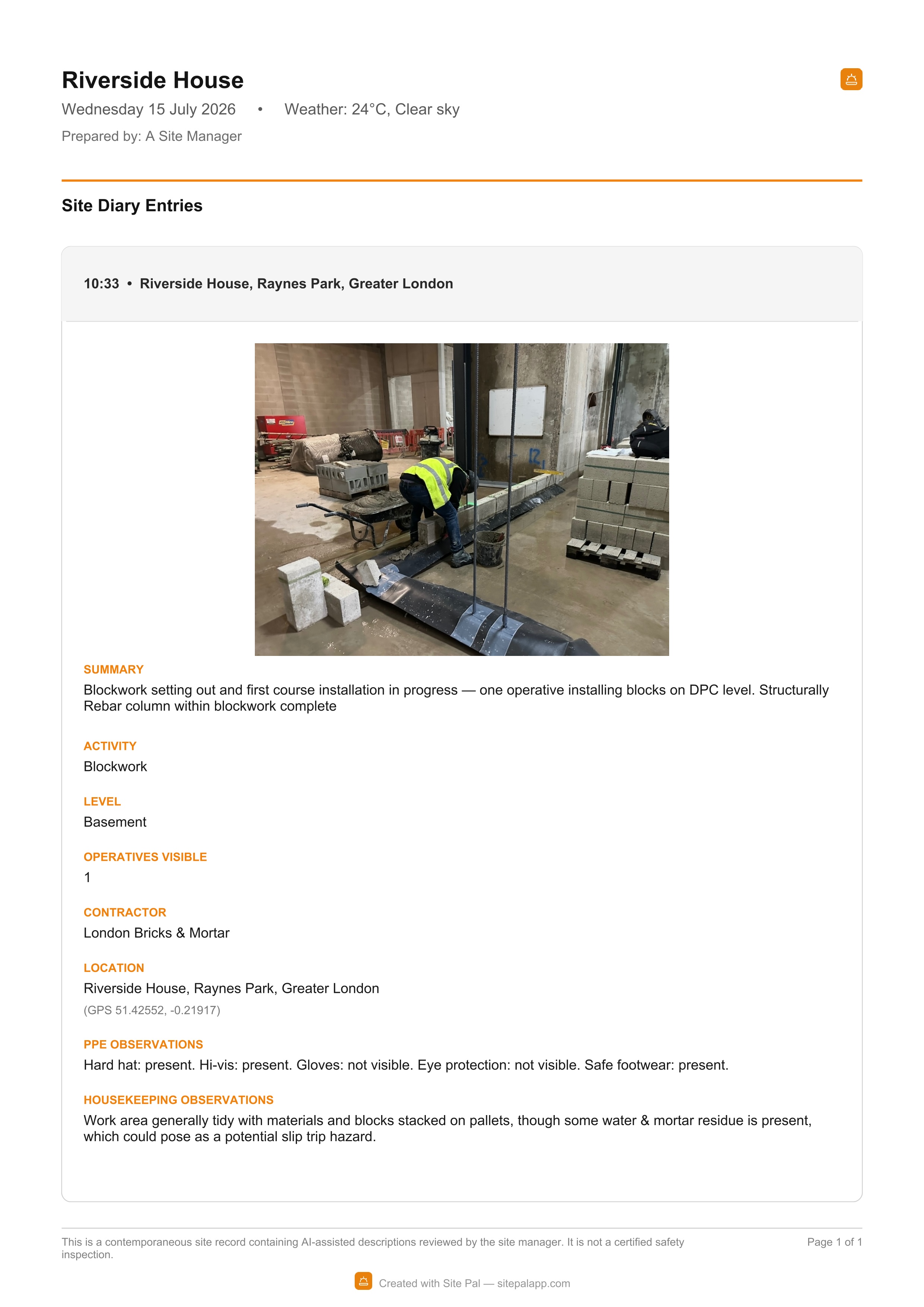
Photographs. A photo with a GPS position and timestamp is a record that argues for itself. Progress photos, delay evidence, condition of areas at handover, deliveries as they arrive. The camera is the cheapest witness you'll ever employ.
The test for what to include: if this day ended up in a dispute two years from now, what would I wish I'd written down? Write that.
How to Write Effective Site Diary Entries
The difference between a diary that wins arguments and one that doesn't is rarely the format. It's the writing habits:
Write it on the day. Every day. An entry written Friday for Tuesday is a reconstruction, and it reads like one. Consistency is what gives a diary its evidential weight — a diary with entries for 340 days of a 342-day job speaks for itself.
Facts, not opinions. "Subcontractor slow" is an opinion and it's worthless. "Brickwork gang of 3 (down from agreed 6), laid approx. 400 bricks against planned 1,000, gable end incomplete" is a fact and it's evidence. Record what you saw, counted and measured.
Be specific about locations and quantities. Level 2, gridlines C–E. Approx. 40 m² of screed. Two of four risers. Specificity is what separates a record from a vague impression.
Name names and times. Who gave the verbal instruction. What time the concrete wagon actually arrived versus when it was booked. Which operatives were stood down and for how long.
Record the negative as well as the positive. The days nothing happened matter as much as the days everything did. "No access to riser — awaiting M&E clearance, day 4" is one line that quietly builds an unanswerable case.
Don't editorialise, don't speculate, don't vent. Diaries get disclosed in disputes — the whole diary, not just your best pages. Every entry should be one you'd be comfortable reading out loud in a formal setting, because one day you might.
Legible and unaltered. If handwritten: pen, no torn-out pages, mistakes struck through with a single line rather than obliterated. If digital: a system that timestamps entries and doesn't allow silent retrospective editing is worth its weight — it removes the "when was this really written?" question entirely.
Site Diary vs Daily Allocation Sheet
These get confused constantly, and mixing them up costs money.
A daily allocation sheet (or daywork sheet/record sheet) is a commercial document, usually a subcontractor's, recording labour, plant and materials allocated to specific work — often work the subcontractor considers to be a variation or daywork. It's typically presented for signature by the main contractor's representative.
A site diary is the factual daily record of the whole site — everything that happened, whoever it happened to.
Why the difference matters:
- Signing an allocation sheet is not neutral. Depending on the contract, a signature can be taken as agreement to the resources recorded, or even acceptance that the work was extra. Many contractors sign "for record purposes only" — but the safest habit is knowing what your contract says a signature means before you sign anything.
- Your diary is your check against their allocation sheets. If the sheet claims 8 operatives on dayworks and your diary recorded 5 on site all day, the diary is what stops the over-claim. No diary, no check.
- They serve different masters. The allocation sheet exists to support a payment application. The diary exists to record the truth. When the two disagree, you want to be the one holding the diary.
Site Diary vs Daily Report
Closely related, often merged, but worth distinguishing:
A site diary is traditionally the site manager's own working record — sometimes internal, warts-and-all, kept for the contractor's benefit.
A daily report (or daily progress report) is usually a formal deliverable — a document issued to the client, the project manager, or up the chain, often in a prescribed format, sometimes a contractual requirement.
Practical differences:
- Audience. The diary is written for a future dispute or a future you. The report is written for today's client. That changes tone: the report is polished; the diary must above all be complete.
- One can feed the other. The efficient workflow is diary first, report extracted from it — never the reverse. A report written for a client and then treated as the only record tends to be missing exactly the awkward details (delays, standing time, information gaps) that the diary exists to capture.
- Don't let the report kill the diary. The most common failure on well-run jobs: the formal reporting regime is so heavy that the informal diary dies, and with it the candid record. Keep both. The diary takes minutes if the system is right.
NEC4 Contracts and Site Diaries
NEC contracts don't generally use the word "site diary" — but they are arguably the contracts that most reward keeping one, because the whole NEC machinery runs on prompt, evidenced communication:
- Early warnings. NEC expects matters that could affect time, cost or quality to be notified early. A daily diary is precisely where those matters first surface — the entry that says "design information for stair core now 5 days late" is the trigger and later the proof that the warning was justified.
- Compensation events are time-barred. NEC notification periods are strict, and events not notified in time can be lost entirely. A daily record is how you spot events when they happen rather than when it's too late, and how you evidence the date you first knew.
- Assessment needs records. Compensation event quotations and assessments turn on actual resource, actual progress and actual effect. The diary entries for the affected period are the raw material. No records, and the assessment becomes someone else's estimate.
- Programme is king under NEC — the diary feeds it. Progress against the Accepted Programme, actual start and finish of activities, the effect of events on planned work: the diary is where the ground truth lives.
The one-line summary: under NEC, a matter that isn't recorded and notified promptly may as well not have happened. The daily diary is the cheapest compliance tool the contract has.
(This section describes common practice under NEC-style contracts in general terms — always check the specific contract and take professional advice on notification requirements for your project.)
Legal and Compliance Requirements
There's no general UK statute that says "thou shalt keep a site diary." But a good diary quietly supports a stack of obligations that do exist:
- Health and safety. CDM and general health and safety duties generate their own formal records (inspections, inductions, incident reports). The diary cross-references and corroborates them — and is often the document that shows the day-to-day reality behind the paperwork.
- Contractual record-keeping. Many contracts expressly require daily records, progress records or reports, and some make payment for certain work conditional on contemporaneous records. Know what yours says.
- Incident evidence. After an accident, the diary entries for the days before and after — who was on site, what was happening in the area, what the conditions were — routinely become important evidence.
- Disclosure. In a formal dispute, site diaries are usually disclosable. That cuts both ways: it's why the diary is powerful, and it's why it should never contain speculation, blame-storming or anything you wouldn't want read out by the other side's barrister.
(General guidance only — for obligations on a specific project, check the contract and take advice from your commercial team or a construction lawyer.)
Retention: How Long to Keep Site Records
How long do you keep site diaries and daily records? The honest answer: longer than you think, and it depends on the contract.
The framing most UK construction professionals use:
- Limitation periods for contract claims in England and Wales run for years after completion — and substantially longer for contracts executed as deeds. Latent defects regimes and recent building safety legislation have lengthened the practical tail on some claims further still.
- The working rule of thumb on many jobs is therefore to retain project records for at least 6 years, and 12+ years where the contract is a deed — with many contractors simply keeping everything for the longer period because storage is cheap and a missing record is not.
- Digital storage changes the maths. The traditional reason records were destroyed was physical: boxes cost money. A digital diary with photos costs effectively nothing to keep forever — which is increasingly the default answer.
Practical points either way:
- Keep records organised and retrievable — a record you can't find in a dispute might as well not exist.
- Keep the photos with the entries, not in a separate phone camera roll that gets wiped when the phone is upgraded.
- If records are personal-data-heavy, retention also has a data protection dimension — retention policies should say what's kept, why and for how long.
(Retention obligations vary by contract, sector and circumstance — set your retention policy with advice from your commercial or legal team, not from a rule of thumb alone.)
Digital Site Diaries vs Paper Logbooks
The majority of UK construction SMEs still run primarily on paper. Here's the honest comparison:
Where paper wins:
- Zero learning curve, zero battery, works in the rain with gloves on
- No subscription, no login, no IT
Where paper loses:
- One copy. Lost logbook, skipped page, coffee, site cabin fire — the record is gone
- No photos attached. The pictures live on someone's phone, unlabelled, undated in any provable way, and leave when they do
- No timestamp proof. A handwritten entry could have been written any time; its evidential weight relies on the author's credibility
- Retrieval. Finding "every entry mentioning the roof" across 18 months of A4 logbooks is a week of someone's life
- Legibility and consistency. Every author, a different standard
Where digital wins:
- Photos GPS-positioned and timestamped at capture — the entry proves itself
- Entries dated and timed by the system, not the author's pen
- Backed up automatically; searchable in seconds; consistent format across every author and every site
- Faster — modern tools generate the written entry from photos and speech, turning a 30-minute chore into a couple of minutes
Where digital can lose:
- A bad tool adds admin instead of removing it — the test is whether the diary takes less time than paper, not more
- Battery, signal and usability in the field are real constraints; a tool that only works at a desk is a report writer, not a site diary
The direction of travel is one-way. The evidential gap between "photo with embedded GPS and timestamp" and "biro entry in a damp logbook" is now so wide that on any job where a dispute is conceivable — which is every job — the digital record is simply a stronger record.
Common Mistakes That Cost Money
The ones that come up in dispute after dispute:
- Gaps. The diary that stops for three weeks in the exact period the delay happened. Gaps don't read as "busy" — they read as "nothing to support the claim," or worse.
- Written up later. Batch-writing a week of entries on Friday produces vague, hindsight-flavoured records that cross-examine badly. On the day, or it's not contemporaneous.
- Opinions instead of facts. "Groundworkers useless again" wins nothing and reads terribly in disclosure. Numbers, locations, times.
- Recording only your own works. The delay that matters is often someone else's — the missing information, the late free-issue materials, the other contractor blocking the area. If it affected the site, it goes in.
- Photos with no anchor. A camera-roll photo with no reliable date, location or caption is barely evidence. Photos need to be tied to the day, the place and the entry.
- Signing others' records carelessly. Allocation sheets and daywork records signed without checking against your own diary — or without knowing what the signature means under the contract.
- The diary that flatters. Recording only good news because the client sees the report. The diary's job is completeness; the awkward entries are the valuable ones.
- One person, one phone, no system. The whole record living in one manager's head, notebook or camera roll — and leaving with them when they move jobs.
- Unretrievable archives. Records kept but unfindable: mixed boxes, unlabelled folders, ex-employees' devices. Kept ≠ usable.
- Starting after the trouble starts. The most expensive mistake of all. Records begun when the dispute appears prove the dispute, not your case. The diary only works if it was always there.
Site Diary Quick Reference
Print this, stick it in the cabin:
Every entry, every day:
- Date / project / author
- Weather AM + PM — and its effect on work
- Labour by trade, with numbers
- Plant on site — working or standing
- Work done — what and where (level, area, gridline)
- Deliveries — received, late, missing
- Delays and causes — however small
- Verbal instructions — who, what, when
- Visitors
- Incidents / near misses (cross-ref formal reports)
- Photos — GPS + timestamp, attached to today's entry
Golden rules:
- On the day, every day
- Facts and numbers, never opinions
- Record other people's works, not just yours
- Write nothing you wouldn't hear read aloud in adjudication
- The best record wins
Related Guides
- What Should a Delay Record Include?
- How to Write a Site Diary Entry
- Free Site Diary Template (PDF, Word & Excel)
- The Best Site Diary Apps in 2026
- Construction Daily Report Example (UK)
Frequently Asked Questions
Is a site diary a legal requirement in the UK?
There's no general statute requiring one, but many contracts require daily records, and health and safety law generates related record-keeping duties. In practice, the commercial and evidential case for keeping one is stronger than any legal mandate would be.
Who should write the site diary?
The person running the site day to day — usually the site manager, with contributions from anyone supervising works. What matters most is that it's written by someone who was actually there, on the day.
Can a site diary be used as evidence in a dispute?
Yes — contemporaneous site records are routinely central evidence in adjudications, arbitrations and litigation, and are generally given more weight than accounts written after the event. Consistency, specificity and being genuinely written on the day are what give a diary its weight.
How long should a site diary entry take?
With a good routine or a good digital tool, minutes. If the diary regularly takes half an hour, the process is wrong — and a diary that's a burden is a diary that stops getting done.
Are photos part of a site diary?
They should be. Photos with embedded GPS and timestamps, attached to the day's entry, are among the strongest records a site can produce.
Digital or paper — does it matter evidentially?
Both are admissible. But digital entries that are system-timestamped, with GPS-tagged photos and no silent editing, answer the "when was this really made?" question in a way paper cannot.
What's the difference between a site diary and a daily report?
The diary is the complete factual record kept for the contractor's benefit; the daily report is usually a formal, polished deliverable issued to the client. Best practice is diary first, report drawn from it.
How long should site records be kept?
Common practice in UK construction is at least 6 years after completion, and 12+ where the contract is a deed — with many firms keeping digital records indefinitely since storage costs nothing. Check your contract and take advice for your specific obligations.
Created with Site Pal — the AI site diary. Walk the site, talk, and your diary writes itself: every photo GPS-positioned and timestamped. Free for 14 days, no card needed at sitepalapp.com