Construction Daily Report Example (UK) — A Worked Example You Can Copy
Last updated: July 2026
Every guide on this subject tells you what a daily report should contain. Almost none of them show you a real one. So here's a full worked example from a UK fit-out, section by section, with an explanation of why each part matters when someone eventually argues about it.
If you'd rather start from a blank form, our free site diary template is here: free site diary template.
What a daily report actually is
A daily report, site diary, daily log, day book, call it what you like, is a dated record of what happened on site. Who was there, what they did, what turned up, what stopped, and what the weather was doing while it happened.
It has two jobs, and most people only think about the first one.
Job one: telling the client and your own office what's going on. That's the one everybody does.
Job two: being the evidence. Six months from now, when there's an argument about why the drylining started three weeks late, your diary is what decides it. Not your memory. Not the programme. The contemporaneous record made at the time by the person who was there.
Under NEC4 you're notifying compensation events with early warnings and supporting records. Under JCT you're substantiating a claim for loss and expense. Either way, the words that matter are contemporaneous and records. A diary written on the day carries weight. A reconstruction written six months later, when you knew there was a dispute coming, carries almost none.
The worked example
This is a Wednesday on a Level 4 commercial fit-out. Nothing dramatic happened, which is the point. Most days are like this, and the boring days are the ones that build the record.
Header
Project: Riverside House — Level 4 Fit-Out
Date: Wednesday 15 July 2026
Prepared by: A. Manager, Site Manager
Weather: 19°C, overcast, dry all day. Light wind.
Working hours on site: 07:30 to 17:00
Why it matters: the date and the author are what make it a contemporaneous record rather than a note. Weather sounds like padding until the week you're claiming for rain, and then it's the whole claim. Record it every day, including the good days, because a diary that only mentions weather on bad days looks written to order.
Labour on site
Main contractor: 1 site manager, 1 assistant site manager
London SAS Electrical — 6 operatives (2nd fix containment, Level 4 north core)
Bexley Drylining — 8 operatives (boarding, Grid E to H)
Kent Mechanical — 3 operatives (ductwork, Level 4 south)
Total on site: 19
Why it matters: operative counts are the single most disputed figure in construction. If you're claiming disruption, prolongation or thickening of preliminaries, this is the number that gets forensically examined. Record actual counts, not what the subcontractor's programme said they'd bring. And record the trade and the location. "8 operatives" is worth much less than "8 operatives boarding Grid E to H".
Work carried out
Level 4 north core — London SAS Electrical continued 2nd fix containment to the north core risers. Approximately 60% complete. Tray installed to Grid A to C at high level.
Level 4, Grid E to H — Bexley Drylining boarding to partitions. First side complete to Grid E to G, second side commenced Grid E. Two partitions at Grid H held pending resolution of the door schedule discrepancy, see Instructions below.
Level 4 south — Kent Mechanical installing primary ductwork above ceiling zone, Grid J to L. Progressing to programme.
Why it matters: be specific about location and quantity. "Drylining continued" tells nobody anything. "First side complete to Grid E to G" is a fact somebody can check against a photograph and a programme. Percentages are useful but only if you're consistent. If you say 60% today, you need to say 75% next week, not go back to "progressing".
Plant and equipment
1 no. 8m scissor lift (Level 4 north, London SAS)
2 no. podium steps (Bexley Drylining)
1 no. 110v transformer and task lighting to Grid E to H
Goods hoist available 07:30 to 16:30, no downtime
Why it matters: plant on site is money on site. If the job is delayed, standing plant becomes a cost you can substantiate. And recording hoist availability protects you when somebody claims they lost half a day waiting for it.
Materials and deliveries
09:15 — 42 no. 15mm plasterboard sheets delivered, Bexley Drylining. Checked against delivery note 47821, quantity correct, no visible damage. Distributed to Level 4 Grid F.
13:40 — Cable tray delivery, London SAS Electrical. Part delivery only, 18 of 30 lengths received. Remainder scheduled Friday 17 July. Supplier delay confirmed by London SAS supervisor.
Back boxes for Level 4 north containment not delivered. Second fix electrical to the wall line cannot commence. See Delays below.
Why it matters: deliveries are timestamped facts. A part delivery, recorded on the day with the delivery note number, is far stronger than "materials were late" written up later. Note what didn't arrive as well as what did. The missing item is usually the one that causes the delay.
Delays and disruption
Delay — 2nd fix electrical, Level 4 north wall line.
Programmed start: 13 July 2026.
Actual start: not commenced as at 15 July 2026.
Delay to date: 3 working days.
Cause: back boxes not delivered to site. Confirmed with London SAS supervisor on site at 10:20. Supplier lead time now quoted as 21 July.
Consequence: void closure of the drylining to Grid A to C cannot proceed, as the wall line cannot be closed until containment and back boxes are installed. Drylining second side to Grid A to C now at risk.
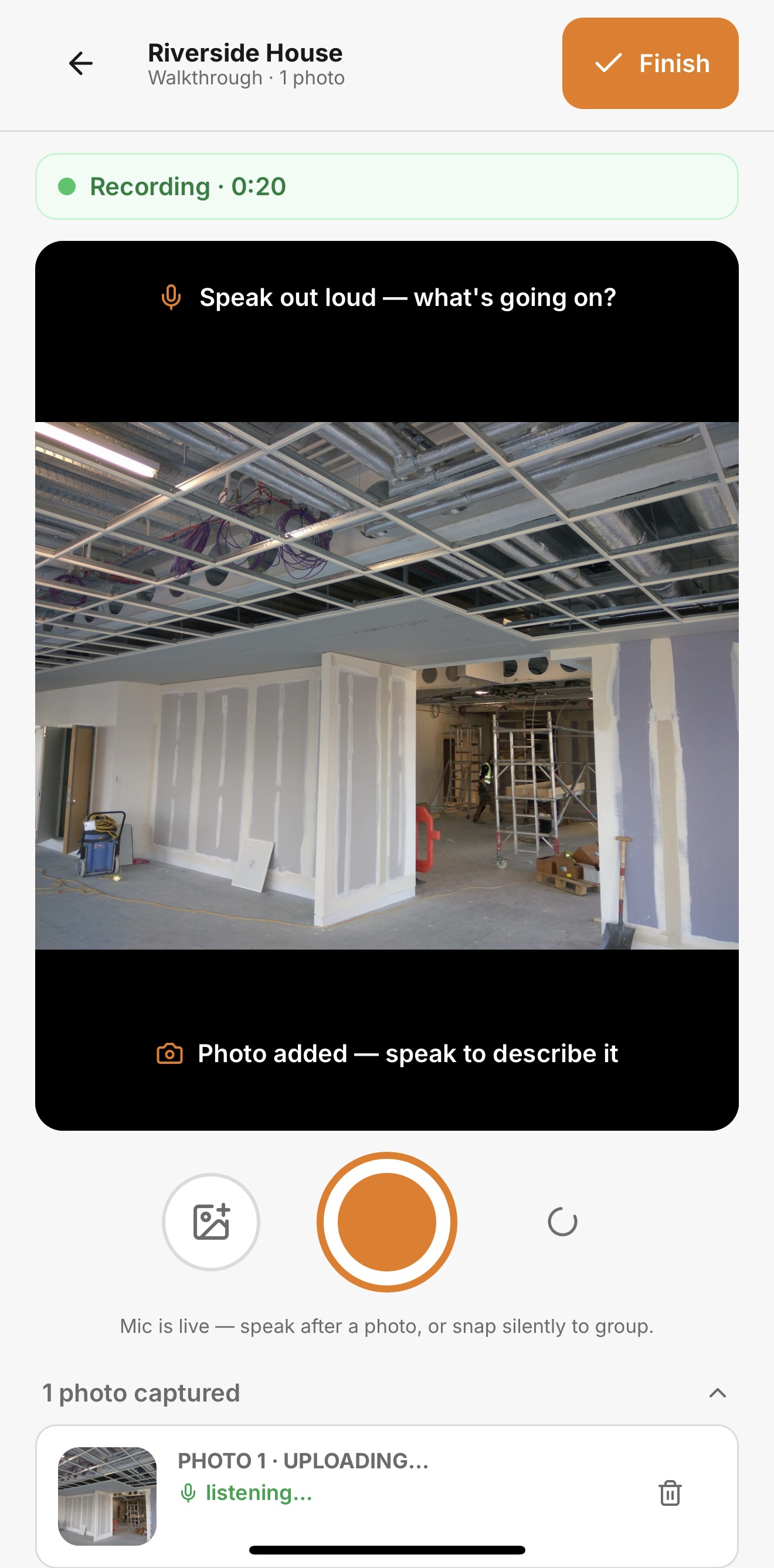
Photographs: 3 no. attached showing open wall line and absent back boxes, timestamped and location-stamped.
Why it matters: this is the single most valuable entry in the whole report, and it's the one most people write as "waiting on electrics". A defensible delay record has five parts: what was programmed, what actually happened, the difference in working days, the cause, and the knock-on effect. Without the knock-on effect you've recorded an inconvenience. With it, you've recorded a delay to the critical path.
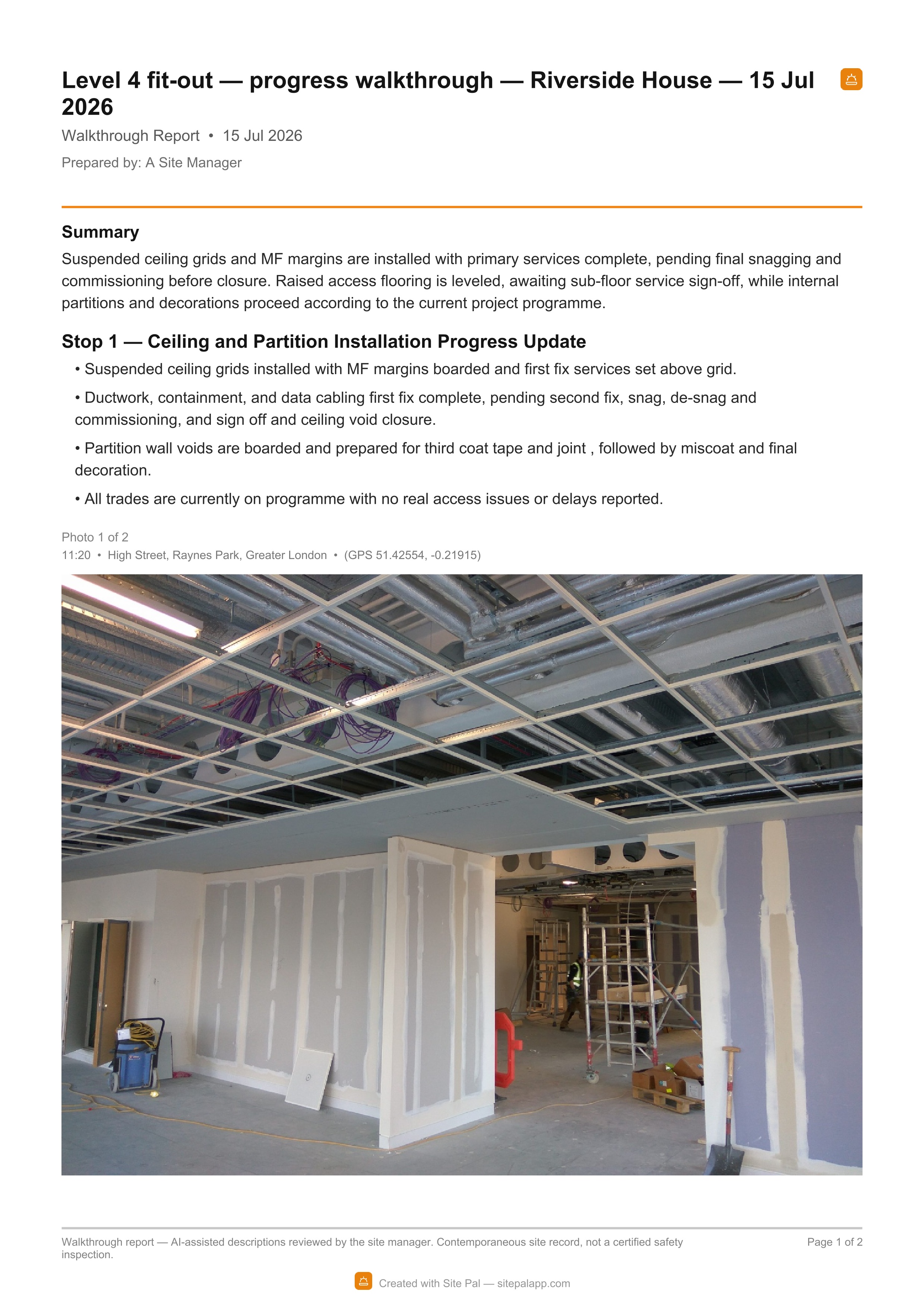
Photographs with a timestamp and GPS turn your account into evidence. A photograph without them is a photograph of a wall.
We've written a full breakdown of delay records here: delay record guide.
Instructions and verbal directions
11:05 — Architect on site, visit 14:00 to 15:30. Verbal instruction to hold the two partitions at Grid H pending clarification of door widths on the revised door schedule. Instruction confirmed to be followed up in writing. Chased same day by email at 16:10, no response as at close of business.
Why it matters: verbal instructions are the classic dispute. Somebody tells you to stop, you stop, and three months later nobody remembers who said what. Record the time, the person, what was said, and, crucially, that you asked for it in writing and whether you got it. That last detail is what makes it credible.
Visitors
14:00 to 15:30 — Architect, design team
15:00 to 15:20 — Client representative, brief walkround of Level 4 north
Why it matters: visitor records establish who saw what and when. Useful when somebody later claims they weren't told about a problem that was visible from where they were standing.
Health, safety and housekeeping
Morning briefing held 07:35, 19 attendees. Topic: working at height, scissor lift exclusion zones.
All operatives observed in correct PPE, hard hat, hi-vis, gloves, safety boots, eye protection where cutting.
Housekeeping: Level 4 Grid E to H generally tidy. Offcut plasterboard accumulating at Grid F. Instruction given to Bexley Drylining supervisor at 15:45 to clear before close. Confirmed cleared at 16:50.
No accidents, no near misses, no notifiable incidents.
Why it matters: "no accidents" recorded every day is worth something. It shows you were watching. And when you do record an issue, like the offcuts at Grid F, recording that you gave an instruction and that it was actioned shows a site under control rather than a site with a problem.
Photographs
8 no. photographs attached. All timestamped, GPS-located.
1 to 3: Level 4 north, open wall line, absent back boxes, delay evidence
4 to 5: Grid E to G boarding first side complete
6: Delivery 47821 on arrival
7: Ductwork progress Grid J to L
8: Grid F housekeeping prior to clearance
Why it matters: photographs are the cheapest evidence there is. Take more than you think you need. Caption them, or make sure your app does, because an uncaptioned photo in a folder called "July" helps nobody in two years' time.
The five mistakes that make a diary worthless
1. Writing it up at the end of the week. Contemporaneous means on the day. A diary written every Friday for the previous five days is not a contemporaneous record and anyone examining it will spot the pattern.
2. Being vague to be safe. "Some delays experienced" protects nobody. If you name the cause and the consequence, you have a record. If you don't, you have a paragraph.
3. Recording problems but not their effect. A missing delivery is an inconvenience. A missing delivery that stops the following trade is a delay. Always write the second sentence.
4. Editing it later. If you go back and change a diary entry after a dispute starts, and the change is visible, you've damaged your own case more than the original entry ever would. Add a dated addendum instead. Never silently rewrite.
5. Only writing on eventful days. A diary with gaps is a diary somebody can argue with. The empty days are what prove the record is complete.
If you want the full picture of what good looks like, we've covered it here: What Does a Good Site Diary Look Like?
Common questions
How detailed does a daily report need to be?
Detailed enough that somebody who wasn't there can reconstruct the day. In practice: location, trade, quantity, and the reason for anything that didn't happen. Ten specific lines beat two pages of general description.
Who should write the daily report?
Whoever was on site. A diary written by somebody who wasn't there carries far less weight, and it'll show, because the detail won't be right.
Do I need to record the weather every day?
Yes. A diary that only mentions weather when it's bad looks like it was written to support a claim. Recording it daily, good and bad, is what makes the bad days credible.
What's the difference between a daily report and a site diary?
Nothing meaningful. Daily report, daily log, site diary, day book, dailies. Different regions and different contracts use different words for the same document.
Should verbal instructions go in the diary?
Always, and note that you asked for written confirmation. The record of the chase is often more useful than the record of the instruction.
Doing this in 90 seconds instead of 20 minutes
Everything above is what a good report contains. Writing it out by hand at the end of a long day is why most people stop after a fortnight.
Site Pal writes it for you. Photograph the works and the AI produces the entry, activity, operatives, PPE, housekeeping, with time, GPS and weather attached automatically. Or walk the site talking and get the whole report as a client-ready PDF at the end. The delay register is built in, so records like the one above get produced as you go rather than reconstructed afterwards.
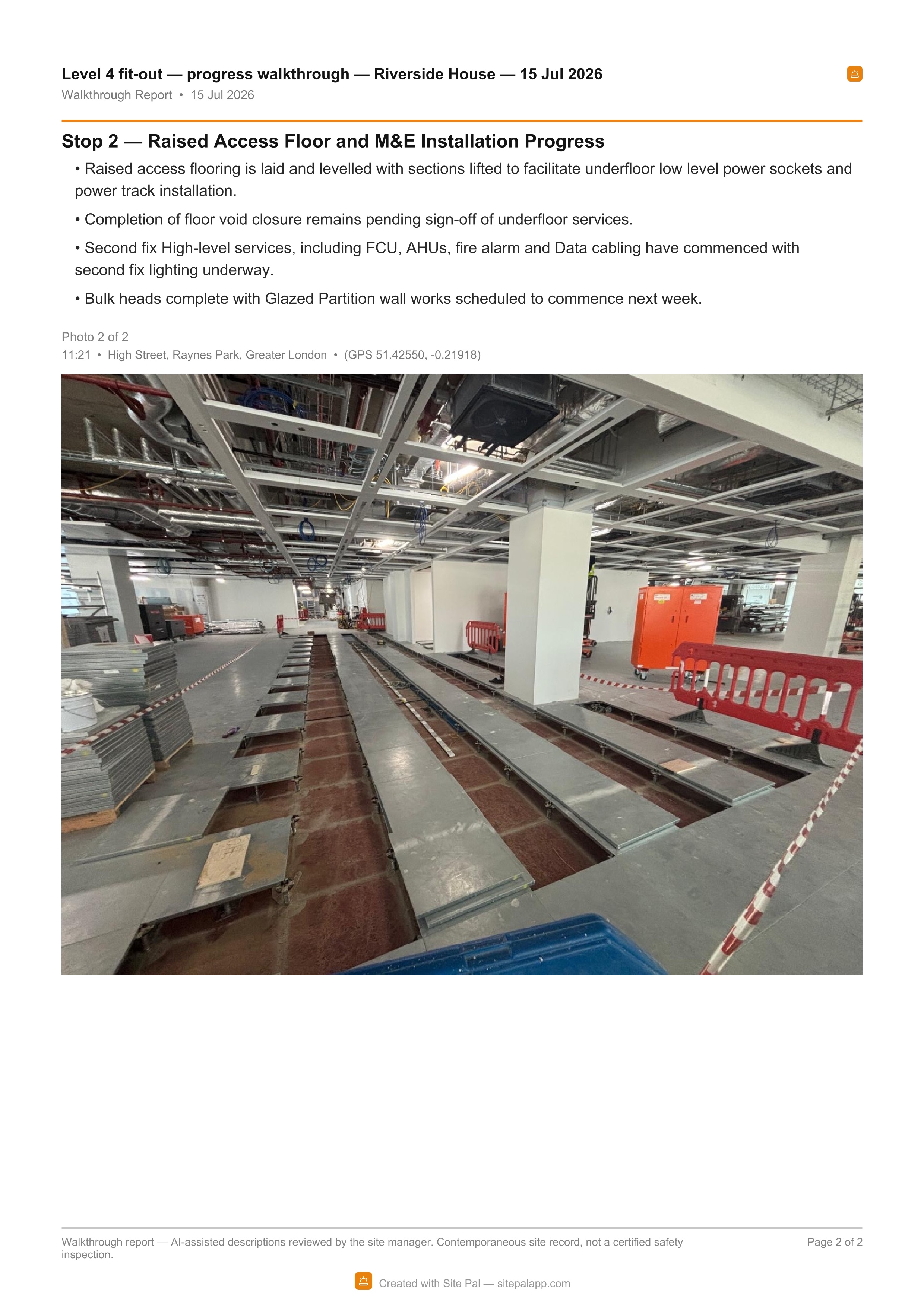
For a period view rather than a single day, see our Construction Progress Report Example.
14 days free. No card needed. Then £19/month.
Something you'd add to this? Tell us, we update it.