Construction Progress Report Example (UK)
Last updated: July 2026
A progress report is the document that tells everyone who isn't on site what state the job is actually in. Below is a worked example from a UK commercial fit-out, section by section, with an explanation of what each part is really for.
There's also a faster way to produce one than sitting at a laptop on a Friday afternoon, and we'll come to that.
Progress report or daily report? They're not the same thing
People use the terms interchangeably and then get confused about what they're writing.
A daily report is one day. Who was on site, what they did, what turned up, what stopped. It's a record, and its main job is evidence. We've covered that separately with a full example here: construction daily report example.
A progress report is a period. Usually a week or a month. It measures where the job actually is against where the programme said it would be, and it goes to people who need to make decisions with it: the client, the QS, the project manager, sometimes a funder.
Daily reports are the raw material. Progress reports are what you build out of them. If your dailies are thin, your progress report will be guesswork.
Who reads it, and what they actually want
The client wants to know whether they're getting the building when they were promised, and whether anything is about to cost them money. They will read the first paragraph and look at the photographs.
The QS or commercial team wants percentages they can value against. Vague progress descriptions cost you money at interim valuation, because what can't be substantiated doesn't get paid.
Your own project manager wants the problems, early, in writing. A progress report that only contains good news is a progress report nobody trusts the second time.
Anyone in a dispute, later wants dates, causes and consequences. Same as a daily report.
Write for all four. It's not as hard as it sounds — be specific, and don't hide anything.
The worked example
This is a weekly progress report on a Level 4 commercial fit-out.
Header and headline status
Project: Riverside House — Level 4 Fit-Out
Report type: Weekly progress report
Period: Monday 13 July to Friday 17 July 2026
Prepared by: A. Manager, Site Manager
Overall status: On programme
Level 4 completion: approximately 58%
What it's for: the headline status is the only thing some readers will take in, so it has to be honest. "On programme" when you know you're a week behind is the fastest way to lose credibility with a client, and it's very hard to get back. If you're behind, say so here and explain it below.
Summary
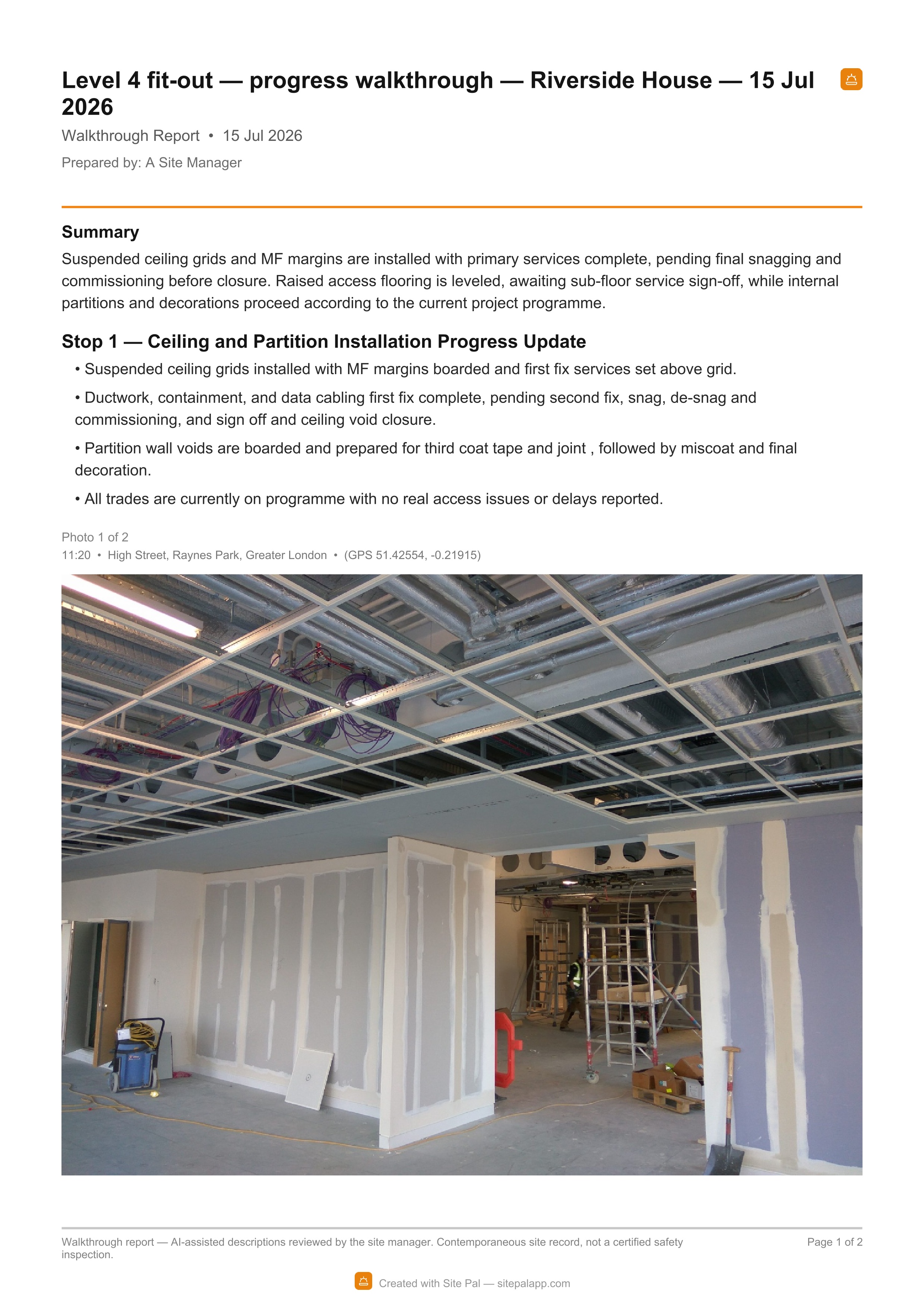
Suspended ceiling grids and MF margins are installed with primary services complete, pending final snagging and commissioning before closure. Raised access flooring is laid and levelled, awaiting sub-floor service sign-off. Internal partitions and decorations are proceeding in line with the current programme.
What it's for: three or four sentences that let somebody understand the state of the job without reading the rest. Write it last, once you know what the report says. Most people write it first and it shows.
Progress by area
Ceilings and partitions — Level 4 north and central Suspended ceiling grids installed with MF margins boarded and first fix services set above grid. Ductwork, containment and data cabling first fix complete, pending second fix, snag and de-snag, commissioning, sign-off and ceiling void closure. Partition wall voids are boarded and prepared for third coat tape and joint, followed by mist coat and final decoration.
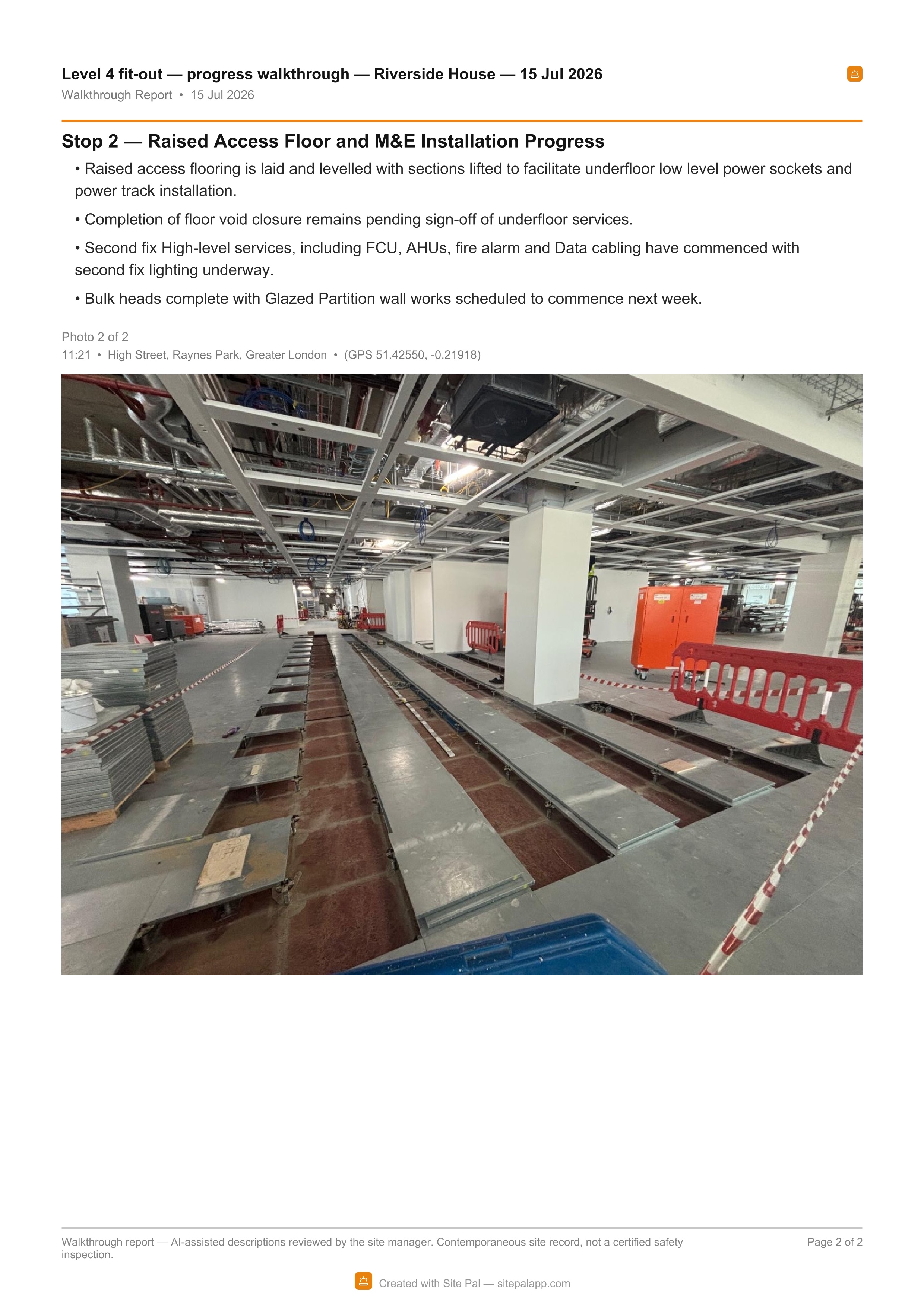
Raised access floor and M&E — Level 4 south Raised access flooring laid and levelled, with sections lifted to facilitate underfloor low level power sockets and power track installation. Completion of floor void closure remains pending sign-off of underfloor services. Second fix high level services including FCUs, AHUs, fire alarm and data cabling have commenced, with second fix lighting underway. Bulkheads complete. Glazed partition works scheduled to commence next week.
What it's for: this is the body of the report and the part that gets read most carefully by anyone valuing the work. Two rules. Be specific about location, because "partitions progressing" is worth nothing. And be honest about what is pending rather than only listing what is complete, because the pending items are where next month's problems live.
Progress against programme
Ceiling grid installation: complete to programme.
First fix M&E: complete to programme.
Second fix M&E: commenced 15 July, one day ahead of programmed start.
Floor void closure: held, pending underfloor services sign-off. Programmed for 16 July, not achieved. Currently 2 working days behind.
Glazed partitions: programmed to commence 20 July, materials on site, no issues anticipated.
What it's for: this is the section that separates a real progress report from a status update. Named activities, programmed dates, actual dates, and the variance in working days. If you only ever add one section to your reports, add this one.
Risks and issues
Floor void closure — 2 days behind. Cannot proceed until underfloor services are signed off. Sign-off requested from the M&E consultant 14 July, chased 16 July, no response as at close of period. Consequence: floor finishes cannot commence, which is on the critical path to handover of the south zone.
No other issues affecting programme this period.
What it's for: the format that matters is issue, cause, what you have done about it, and consequence. "Awaiting sign-off" is a note. "Awaiting sign-off, requested on the 14th, chased on the 16th, and it is now holding the critical path" is a record that protects you.
Labour and resource
Average operatives on site this period: 19 per day
Peak: 23, Thursday 16 July
Trades on site: electrical, drylining, mechanical, ceilings, flooring
No labour shortages affecting progress this period.
What it's for: resource levels are what get examined if there is ever a disruption or prolongation claim. Averages across a period are much more useful than a single day's headcount.
Health, safety and quality
Toolbox talks: 5 held this period. Topics: working at height, manual handling, silica dust, PPE, housekeeping.
Accidents: none. Near misses: none reported.
Inspections: 1 client-side safety walk, 15 July. No actions raised.
Snagging: de-snag of Level 4 north ceilings commenced, 12 items raised, 4 closed.
What it's for: clients read this section for reassurance and regulators read it for compliance. Recording snag counts opened and closed is more useful than describing snagging in words, because it gives everyone a trend.
Look ahead — next period
Commence glazed partition installation, Level 4 south
Third coat tape and joint to partitions, Level 4 north
Continue second fix lighting and data
Priority: obtain underfloor services sign-off to release floor void closure
What it's for: a two-week look ahead turns a backward-looking report into something useful. Putting the blocker at the top as a priority also puts it in writing that you have asked, which matters if it drags on.
The bit nobody else writes about: producing it while you walk
Every other guide on this subject tells you to gather your site logs, collect input from your supervisors, organise it into sections and write it up. In other words, a desk job, done afterwards, from documents.
That is why progress reports get written on Friday afternoons by people who are already tired, from notes that may or may not be accurate, and why they get thinner every week.
There is another way to do it, and it is obvious once you have tried it: write the report while you are doing the walk.
You already walk the job. You already look at the ceiling void and know it is waiting on commissioning. You already know the floor cannot close until the consultant signs off. The information exists in your head at the moment you are standing in front of it, and that is the moment it is most accurate.
Site Pal is built around this. You start a walkthrough, walk the site describing what you see the way you would describe it to your foreman, and photograph as you go. Each photograph gets matched to what you said about it, with time and GPS attached. At the end you get a client-ready PDF, structured by stop, with the summary written for you.
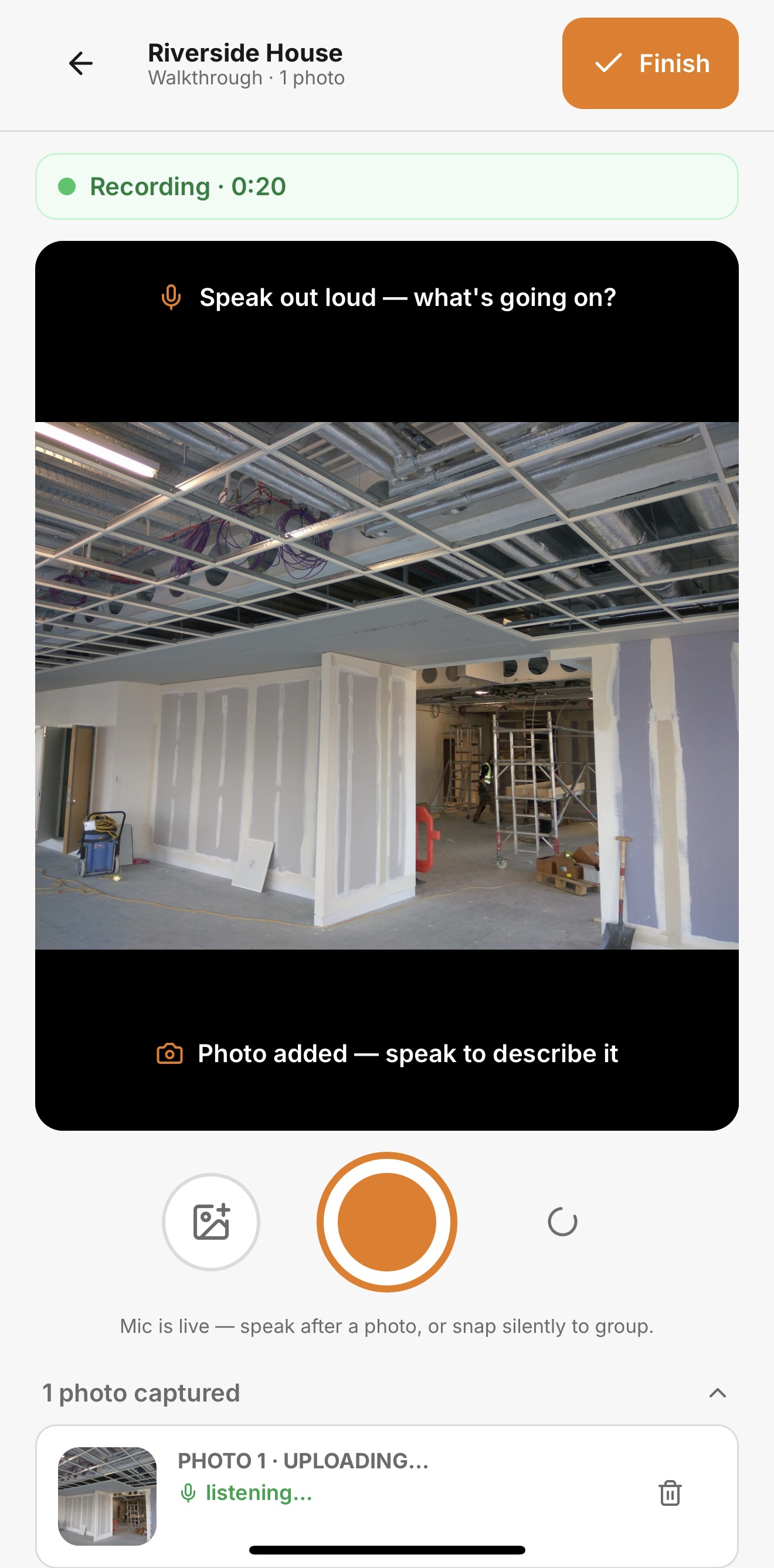
The two report pages shown above were produced that way. Ten minutes of walking and talking, no typing.
That does not remove the thinking. You still decide what matters and you still review it before it goes out. It removes the transcription, which is the part that makes people stop after a fortnight.
Five mistakes that make a progress report useless
1. No dates against activities. "Second fix commenced" tells nobody whether that is early, late or on time. Programmed date, actual date, variance.
2. Only reporting the good news. A report with no issues in it is a report that gets ignored, and it destroys your credibility the first time something surfaces that you clearly knew about.
3. Percentages that move backwards. If you say 58% this week, next week must be higher or you must explain why. Inconsistent percentages get every other figure questioned.
4. Recording a blocker without recording the chase. "Awaiting sign-off" is passive. "Requested 14th, chased 16th, no response" shows you did your bit.
5. Writing it days later from memory. Same problem as a late daily report. The detail degrades fast, and it shows.
For more on what good records look like generally: What Does a Good Site Diary Look Like?
Common questions
How often should a progress report be issued?
Weekly on most fit-out and refurbishment jobs, monthly on larger new-build programmes. Whatever the contract requires, and then consistently. An irregular report is worse than a short one.
What's the difference between a progress report and a daily report?
A daily report covers one day and is primarily a record. A progress report covers a week or month and measures actual progress against the programme. You build progress reports out of daily reports.
Who writes the progress report?
Usually the site manager or project manager, with input from subcontractors and the commercial team. Whoever writes it needs to have actually been on site during the period, or the detail will not stand up.
How long should a progress report be?
Long enough to answer the four readers' questions and no longer. One to three pages plus photographs is normal for a weekly report. Nobody reads eight pages.
Do photographs need to be in the report?
Yes, and captioned with time and location. Photographs are what turn a written claim about progress into something a client can verify without visiting.
Can a progress report be used as evidence in a dispute?
Yes, and regularly is. A contemporaneous report showing programmed dates, actual dates, causes and the fact you notified people is strong material. One written months later, once a dispute was in view, is not.
14 days free. No card needed. Then £19/month.
Something you'd add to this? Tell us, we update it.